Kay Wheeler Moore

Welcome to my blog

Hello. . .

The Newfangled Country Gardener is for anyone who has a garden, would like to have a garden, or who simply enjoys eating the garden-fresh way. I don't claim to be an expert; in this blog I'm simply sharing some of the experiences my husband and I have in preparing food that is home-grown.

About the author

Kay Wheeler Moore is the author of a new cookbook, Way Back in the Country Garden, that features six generations of recipes that call for ingredients that are fresh from the garden. With home gardening surging in popularity as frugal people become more resourceful, this recipe collection and the stories that accompany it ideally will inspire others to cook the garden-fresh way and to preserve their own family food stories as well. The stories in this book center around the Three Red-Haired Miller Girls (Kay's mother and aunts) who grew up in Delta County, TX, with their own backyard garden so lavish that they felt as though they were royalty after their Mama wielded her kitchen magic on all that was homegrown. Introduced in Kay's previous book, Way Back in the Country, the lively Miller Girls again draw readers into their growing-up world, in which a stringent economic era--not unlike today's tight times--saw people turn to the earth to put food on the table for their loved ones. The rollicking yarns (all with recipes attached) have love, family, and faith as common denominators and show how food evocatively bonds us to our life experiences.

Wednesday, March 9, 2011

Will Omega-3's in this recipe bring good exam results? If they don't, at least the black-eyed peas will bring good luck.

The day was two months away, then the day was two weeks away, then the day was two days away, then the day was tomorrow. The day was the date for my annual physical with my G.P. It was The Moment of Truth. No matter how much I repeat the phrase, “I’m in terrific health; I’m in terrific health”, I was about to encounter the one I couldn’t fool, even with my mantras. My G.P. (after a little blood-letting, of course) would know the numbers. He’d tell me whether all my efforts during the past year had paid off.

What to eat the night before my annual physical exam? (a meal, of course, which would be my last food to ingest before my fast began—necessary for accurate bloodwork). Only one solution to that, of course—fish and more fish. I wanted those bad-cholesterol numbers in the bloodwork to be as low as possible. Just a little more fish, after consuming it and nuts and oatmeal and fish-oil tablets all year, would never hurt.

Actually, I couldn’t help be a tad excited about this necessary evil, the annual exam. It would be my first checkup since I became a runner 15 months ago and since we began Hubby’s Extreme Healthy Eating Plan, prompted by his uncomplimentary bloodwork in November 2009. Last year’s physical occurred after I had only about three months of our new-world order under my belt. This year’s would be the first to reflect a whole 12 months of running and major outrageous eating.

My “last supper” featured my Big Easy Gumbo recipe from Southern Living. Lots of sweet onion, green bell pepper, and celery went into the stock pot; fiberific black-eyed peas, cooked chicken, turkey sausage, and the seafood element—shrimp, all served over brown rice. This hearty Creole gumbo was super-filling and would tide me over until after I could break my fast with a late-breakfast after the exam. (Years ago I learned to book the earliest-possible appointment time so I could resume eating as quickly as possible.)

Back to the recipe. Hubby and I just loved the Gumbo. The minced garlic and salt-free seasoning were just enough to spice up the mixture. The recipe made enough for dining before 10 pre-doctor’s visits. Hopefully that last boost of Omega-3’s from the fish will put me over the top for a good report.

I may well file this recipe under my New-Year’s Day recipe section since it features black-eyed peas. Looks to me as though it would make a good lucky ticket for a new year. We’ll see if it was my lucky ticket for a successful annual exam.

“Big Easy” Gumbo

1/2 cup peanut oil
1/2 cup all-purpose flour
1 cup chopped sweet onion
1 cup chopped green bell pepper
1 cup chopped celery
2 teaspoons salt-free Creole seasoning
2 teaspoons minced garlic
3 (14-ounce) cans low-sodium chicken broth
4 cups shredded cooked chicken
1/2 pound turkey sausage, cut into 1/4-inch-thick slices
1 1/2 cups frozen black-eyed peas, thawed
1 pound peeled, large raw shrimp (16/20 count)

Heat oil in a large Dutch oven over medium-high heat; gradually whisk in flour and cook, whisking constantly, 5 to 7 minutes, or until flour is chocolate-colored. (Do not burn mixture.) Reduce heat to medium. Stir in onion and next 4 ingredients and cook, stirring constantly, 3 minutes. Gradually stir in chicken broth; add chicken and next 2 ingredients. Increase heat to medium-high and bring mixture to boil. Reduce heat to low and simmer, stirring occasionally, 20 minutes. Add shrimp and cook 5 minutes or just until shrimp turn pink. Makes 8 to 10 servings.


Tuesday, March 8, 2011

No more teasing about a funny-sounding ingredient; Mediterranean Salad's power-packed

I doubt that I’m the only person that has succumbed to doing a “sounds-like” on bulgur’s funny name. When I first saw the title of Citrus Bulgur Salad about which I blogged some weeks ago, I couldn’t help myself—it just “sounded like” Citrus Vulgar Salad to me. I mean, who eats bulgur on a regular basis? Certainly not me—that is before I became a fan.

Well, no longer do I get anywhere close to tee-heeing about bulgur being “vulgar”. Citrus Bulgur Salad brought lots of accolades, including mine. So recently when Southern Living (in that same marvelous issue that spawned yesterday’s Praline Pecan French Toast) featured Mediterranean Chicken Salad that had bulgur as one of its chief ingredients, I yanked that recipe up quickly and had to try it.

The bulgur wheat, with its mild, nutty flavor, gets prepared in the same way one might prepare rice on the stovetop: two cups of water to one cup of bulgur; boil, reduce heat, simmer for 20 minutes or until tender. Into that mixture, once cooled, goes all kinds of good garden stuff: chopped tomatoes, cucumber, red onion, fresh parsley. Toss in cooked chicken, feta cheese, garlic, salt substitute, and fat-free Italian dressing. Chill a little while or serve immediately over spinach or Bibb lettuce. (Remember that bulgur’s main redeeming quality is that it’s a great source of dietary fiber and protein. As I mentioned earlier, just a single portion of bulgur provides nearly all of the daily requirement for whole-grain foods.)

Well, this salad recipe made oodles and oodles; we’ll be sorry to see it finally disappear from the jumbo salad bowl. Hubby uses this appellation a lot: “best salad ever”, but in this case, I think he may be right for all-times.

Mediterranean Chicken Salad

2 cups boiling water
1 cup uncooked bulgur wheat
1 1/2 teaspoon salt, divided (or salt substitute)
3 cups chopped cooked chicken
1 cup grape tomatoes, halved
2 garlic cloves, pressed
3/4 cup chopped fresh parsley
1/2 cup bottled fat-free Italian dressing
1/4 cup finely chopped red onion
1 (4-ounce) package crumbled feta cheese
1 medium cucumber, peeled and chopped
1 head Bibb lettuce or spinach leaves

Combine boiling water, bulgur wheat, and 1 teaspoon salt substitute. Cover and allow to simmer for 20 minutes or until bulgur is tender. Drain and rinse with cold water. Allow to cool slightly. Combine bulgur wheat, chicken, next 7 ingredients, and remaining 1/2 teaspoon salt substitute. Serve over greens. Makes 6 servings.


Monday, March 7, 2011

Oodles of syrupy pecans get weekend morning moving with this delectable French toast

This past Saturday morning called for a power breakfast that was needed to keep us pumped for a LO-O-O-O-NG day of errands. Time away to visit son and family out West had been terrific, but now we were back to get-serious time in terms of putting our lives here back in order.

Part of that re-entry involved catching up on those unavoidable tasks that pile up when we’re out of pocket. Wal-Mart, grocery, a little pre-Easter prep, etc., all awaited; some of those required Hubby’s presence. Fortify him well, I reasoned, so he’s a willing accomplice to all the “Honey-Do”s that lie ahead.

After the breakfast I hatched up, Hubby might well have been primed to say yes to diamonds and pearls (I didn’t try, mind you, but I could have.) Breakfast consisted of none other than a dish temptingly titled Praline-Pecan French Toast, adapted from a recipe out of a recent Southern Living magazine that featured old Southern standbys with a new twist. The recipe’s tagline read, “A short-order breakfast special gets an easy hands-off finish in the oven.”

I have to admit, this dish doesn’t look very promising when it’s baking. I had to keep peeking at it through the oven-door window and kept murmuring, “Southern Living, I don’t know about this . . ..” From top-side up it simply resembled a bunch of wheat-bread scraps stirred around in a bread bag and shaken out into a 13-inch-by-9-inch glass pan.

After I pulled the baked item from the oven, however, I turned the bread slices onto a dish with their bottom sides flipped over. During the cooking the bread had been baking in a pool of melted butter, brown sugar, sugar-free maple syrup, and broken pecans. Overnight the bread had soaked in a mixture of egg substitute, skim milk, sugar, cinnamon, and vanilla. Once turned out onto its serving dish the pecan mixture in which it had baked became a crumbly, golden, nut topping that crowned the browned French toast. The broken nuts, saved from a previous pecan harvest from our pecan trees, had cooked up crisp and sweet. I sprinkled on a little powdered sugar, a requisite for any French toast. Then I summoned Hubby for the breakfast of his dreams.

Not one extra dab of syrup was needed for this breakfast delight, fit for a king (or the king of my house, anyway). Sure did make the errands that stretched out ahead look an awful lot sweeter.

Praline-Pecan French Toast

8-10 torn slices (day-old) whole-wheat bread
1 cup firmly packed brown sugar (or brown-sugar substitute)
1/3 cup butter, melted
2 tablespoons sugar-free maple syrup
3/4 cup chopped pecans
4 large eggs (or 1 cup egg substitute, lightly beaten)
1 cup skim milk
2 tablespoons granulated sugar (or sugar substitute)
1 teaspoon ground cinnamon
1 teaspoon vanilla

Stir together brown sugar and next two ingredients; pour into a lightly greased 13-inch-by-9-inch glass baking dish. Sprinkle broken pecans over brown-sugar mixture in baking dish. Whisk together eggs and next 4 ingredients. Arrange torn bread pieces over pecans; pour egg mixture over bread. Cover with plastic wrap and chill 8 hours or overnight. Preheat oven to 350 degrees. Bake bread 35 to 37 minutes or until golden brown. Turn out, pecan-side up, into individual serving dishes. Sprinkle with powdered sugar. Serve immediately. Makes 8 to 10 servings.


Friday, March 4, 2011

Line up all this green for St. Paddy’s Day, just around the corner

Nobody in our part of Texas really believes that winter won’t trick us with another sneak blast before we can kiss Jack Frost goodbye permanently. Rumblings yesterday at Roach Feed & Seed, Garland’s local supplier of gardening goods and advice, were that before the end of the month, a last bad freeze likely is due in. I peek out my back door at the burgeoning lettuce leaves struggling to keep their heads above the garden soil and wonder whether they can be survivors through another round of Arctic Attack.

While I wait for nature’s bounty from my own garden, I still have a partial bag of romaine lettuce left over from Three-Leaf Salad, the Wonder Salad I blogged about earlier in the week. Time for Lemony Lettuce, a second dressed-up lettuce recipe across the page from Three-Leaf Salad in my “Celebrating a Healthy Harvest” cookbooklet.

Talk about a tangy dressing that just makes the dish! The lemon-oil-and-vinegar, spiked with ground mustard, salt, and pepper, brings those lettuce leaves to life. As with the mundane-looking Three-Leaf Salad that ultimately got rave reviews, Lemony Lettuce amazes with its understated potential for being the most talked-about item on a buffet table.

With all this healthy green, I’m thinkin', line this recipe up for St. Paddy’s Day, which, after all, is just around the corner.


Lemony Lettuce

1 large head romaine lettuce
1 avocado, peeled, cut up into chunks
2 tablespoons olive oil
2 tablespoons lemon juice
1/2 teaspoon salt
1/2 teaspoon pepper
1/2 teaspoon mustard

Rinse romaine pieces under cold running water. Shake off excess water and dry with paper towels. Place in salad bowl. Add cut-up avocado. Combine dressing ingredients in a screw-top jar. Cover and shake well. At serving time drizzle dressing over lettuce leaves and toss.


Thursday, March 3, 2011

Bringing home the Best of the West yielded an elegant citrus delight

As I’ve blogged earlier, the recent cover story about citrus in Southern Living magazine couldn’t have appeared at a better time. There we were departing Citrus Heaven, in the Western region of this country, and toting home a bag absolutely bursting with fresh citrus we’d procured from our son’s back yard. I’ve never had the nerve to try to replicate something that magazines paid big bucks to style for their cover, but this time I couldn’t help myself. I HAD to try Elegant Citrus Tart that graced the front of this issue.

Never mind that I didn’t own a tart pan and had to use a regular pie plate for my creation. Never mind that my grapefruit and orange sections didn’t fan out exactly as perfectly as SL’s did. I went with what I had and went with my own imperfect arrangement. My version still looked dramatic and fabulous, if I do brag so myself.

The tart (or pie, in my situation) begins with a crust that’s whisked up in a food processor. It features toasted coconut, flour, and powdered sugar pulsed together, with butter and coconut flavoring added. Cold water is sprinkled in until a dough forms. The dough then is rolled out onto a floured pastry board until it’s in a round shape to fit the pie (or tart) pan.

Best to have already made the Buttery Orange Curd filling, or else you have to cool your heels. The curd, made on the stovetop as one would a pudding, has to refrigerate for 8 hours or overnight, so even though you have a perfectly browned crust now ready, if your filling hasn’t chilled properly, you have to wait a LONG time to finish the tempting treat. Beyond that, be sure to have your citrus sections already prepared, or you’ll go into another stall. Grapefruit of various varieties and orange sections must be cut out neatly from the assorted fruit. Best to drain the sections on a paper towel to eliminate extra juice before topping the curd.

Finally, however, with all the pieces ready, assembling the tart is a breeze. Atop the Buttery Orange Curd, which is atop the crust, start with the darkest grapefruit (the magazine suggests the Florida-grown Ruby Red and the Rio Star from Texas, if you don’t have access to the backyard citrus grove that we raided) in the center and work the arrangement out to the edges. Use the lighter-colored navel oranges for the rim.

This might have been designed for a dessert, but I had waited an excruciatingly long time to try this creation and would not be deterred. I finished it in the early morning hours, photographed it, and immediately carved myself a slice for breakfast. Then I promptly called for Hubby. “Life’s too short! You have to sample some of this NOW!” So he forewent his constitutional breakfast oatmeal and dove in for a treat, too.

Ohboy, ohboy, ohboy. Worth the effort of sectioning all those citrus bits. Worth the effort of waiting overnight. And healthy, healthy, healthy. You’ll see what I mean. Life’s too short not to try it soon.

Elegant Citrus Tart

1/3 cup sweetened flaked coconut
2 cups all-purpose flour
2/3 cup powdered sugar
3/4 cup cold butter, cut into pieces
1/4 teaspoon coconut extract
Buttery Orange Curd (see below)
9 assorted citrus fruits, peeled and sectioned

Preheat oven to 350 degrees. Bake coconut in a single layer in a shallow pan 4 to 5 minutes or until coconut toasted and fragrant, stirring halfway through; cool completely (about 15 minutes). Pulse coconut, flour, and powdered sugar in a food processor 3 to 4 times or until mixture is combined. Add butter and coconut extract and pulse 5 to 6 times or until crumbly. With processor running, gradually add 3 tablespoons water and process until dough forms a ball and leaves sides of bowl. Roll dough into a 10-inch circle (about 1/4-inch thick) on a lightly floured surface; press on bottom and up sides of a 9-inch round tart pan with removable bottom (or 9-inch pie pan). Trim excess dough and discard. Bake at 350 degrees for 30 minutes. Cool completely on a wire rack, about 40 minutes. Spread Buttery Orange Curd over crust. Top with citrus sections. Chill. Makes 8 servings

Buttery Orange Curd

2/3 cup sugar (or sugar substitute)
2 1/2 tablespoons cornstarch
1 1/3 cups orange juice
1 large egg, lightly beaten (or 1/4 cup egg substitute)
3 tablespoons butter
2 teaspoons orange zest
pinch of salt (or salt substitute)

Combine sugar and cornstarch in a 3-quart saucepan; gradually whisk in orange juice. Whisk in egg. Bring to a boil; continue boiling, whisking constantly, 3 to 4 minutes. Remove from heat; whisk in butter, zest, and salt. Place heavy-duty plastic wrap directly on curd (to prevent a film from forming); chill 8 hours. Pour over crust.


Wednesday, March 2, 2011

How to cook plantains? Don’t bite into them and expect a banana taste.

My hubby has been on a potassium and magnesium hunt like some people hunt buried treasure.

He’s been reading about how a boost in potassium and magnesium actually constitutes a natural way for preventing hypertension. For years, on that account we've watched the sodium content in foods.

Now the new deal seems to be boosting the body’s consumption of potassium and magnesium to keep one’s blood pressure from soaring to new heights. With Hubby many new foods (well, new to him in terms of daily intake) now regularly go down the hatch: a box of raisins a day, multiple bananas, and anything that would help lower BP via a natural means and not through medication.

His latest discovery was about plantains. In a new book, The Doctor's Book of Food Remedies,
plantains were tub-thumped as being practically a wonder-food (although they hardly taste like its look-alike cousin, a banana. Bite into a raw plantain would be like taking a bite of uncooked potato. Yuk!). One cup of sliced, cooked plantain delivers a potassium lode of 716 milligrams, or about 20 percent of the recommended daily value. Not only is it a key mineral to counteract hypertension, a potassium-rich diet reduces the risk of stoke significantly, prevents and treats ulcers, and prevents constipation.

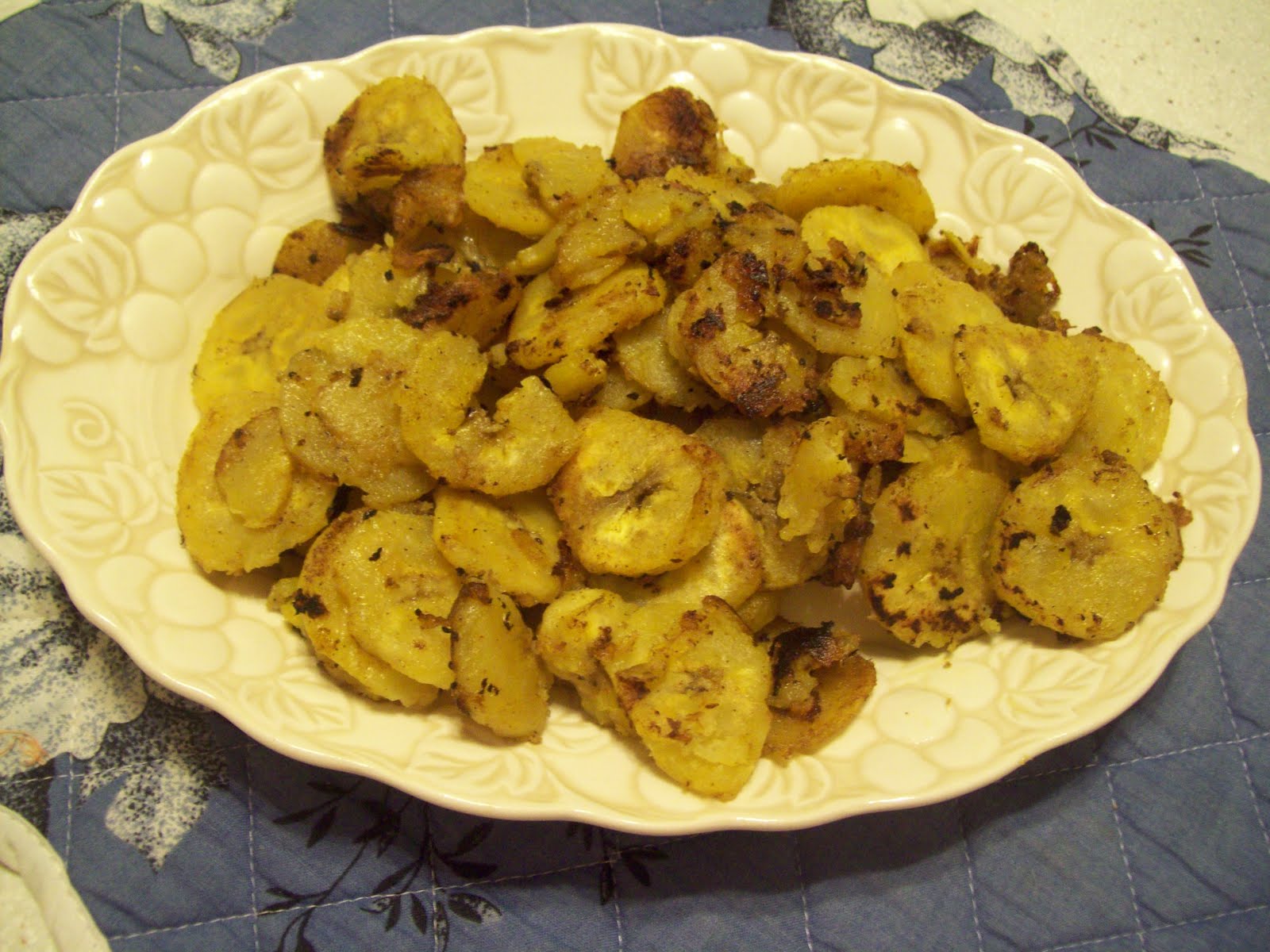
The new book just mentioned happily includes some recipes after each food is discussed. Happily because I’d otherwise have no idea what to do with a raw plantain. Plaintains with Garlic and Thyme was the first recipe it mentioned. Hubby helped me prepare this one, since seeing is believing was his motto, too, about how this unusual dish would turn out.

I’m pleased to report a pleasant surprise. The cooked plantain (it had to be steamed first before it was stir-fried) tasted more like skillet fried potatoes than anything banana-y. It had a wonderful texture and flavor (when tossed with the recommended garlic, paprika, salt, and thyme.) Hubby said he could eat it without pouring ketchup on it (for him, a real accomplishment). I can see it served with meat loaf or other meat dishes; I also sprinkled a little grated Cheddar cheese on top because a little cheese perks up anything and adds to the color.

A final factoid about plantains: they’re reputed for strengthening the immune system. This means being able to better stave off whatever illnesses travel your way. Not a bad commendation when you realize we’re still in the midst of the flu season (Hubby and I both were laid low with the Bad Old Flu just about this time 35 years ago. It’s not a situation we want to repeat.)

Wonder food? Now I understand it. The newly concocted Plantains with Garlic and Thyme provided a truly teachable moment.

Plantains with Garlic and Thyme

2 large green plantains
2 cups water
1 1/2 teaspoons dried thyme
1 teaspoon paprika
1/4 teaspoon salt
4 teaspoons olive oil
3 cloves garlic, minced

Cut the tips off both ends of the plantains and discard. Run a knife lengthwise down a “seam” of each plantain. Peel off and discard the skin. Cut into 1/8-inch thick slices. In a large nonstick skillet, bring the water to a boil over medium heat. Add the plantains. Cover and simmer until tender, about 15 minutes. Test for doneness by inserting the tip of a sharp knife into a slice. With tongs or a slotted spoon, remove the plantains to paper towels to drain. Pour off the liquid from the skillet and wipe the skillet with paper towels. In a large bowl combine the thyme, paprika, and salt. Add the plantain slices and with your hands toss to coat. Add the oil to the skillet and heat over medium-high heat. Add the plantain slices and spread them evenly in the skillet. Cook until the plantains are golden on the bottom, 2 to 3 minutes. Turn and scatter the garlic over the plantains. Cook for another 2 to 3 minutes or until golden on the bottom. Toss gently to coat with the garlic. Makes 4 servings.


Tuesday, March 1, 2011

Thoughts of spring not far away with this Three-Leaf Salad

When we left for our Westward journey some weeks back, our part of Texas still was in the clutches of icy winter. We’ve returned to glorious spring—gorgeous, bright days, jonquils filling the flowerbeds, mild temperatures. What a transition—hooray!

On return, one of the first things we did was to inspect how the garden had fared during Jack Frost’s icy grip. The lettuce leaves that we thought might be so tender that they would succumb actually were hale and hardy. Onions seemed OK, too. Harvest days for our winter plantings may be just around the corner.

I had spotted this recipe earlier and had thought it would be a wonderful celebratory dish when we bring in our own crunchy lettuce. I couldn’t wait to try it, however, so into the salad bowl went three kinds of storebought greens. Hopefully our own will be ready for the next serving.

The ingredients were so simple, I couldn’t imagine how tasty this salad would be. But after downing one bowlful I kept going back for more. I also couldn’t help but think that this should be relegated to the Christmas-recipe section of my binder—the bright red of the pepper and the holiday green of the lettuce and spinach were Christmas colors, for sure.

But thoughts of next Christmas don’t linger around too long with these pretty springlike days that get us ready for one of the most beautiful seasons of all. Can planting our next garden be too far behind?

Three-Leaf Salad

1 head romaine lettuce
2 cups fresh spinach
1/4 head iceburg lettuce
1 large red Bell pepper, cored
3 tablespoons cooking oil
3 tablespoons vinegar
1/4 cup Cheddar cheese, grated
1 teaspoon salt (I used salt substitute)
1/2 teaspoon pepper

Rinse all greens and slice into thin shreds. Put shreds into a large salad bowl. Cut pepper lengthwise into thin strips; add to the bowl. In a small container blend oil, vinegar, salt, and pepper. Pour over salad and toss to coat. Add cheese and toss again. Serve immediately. Makes 4-6 servings.